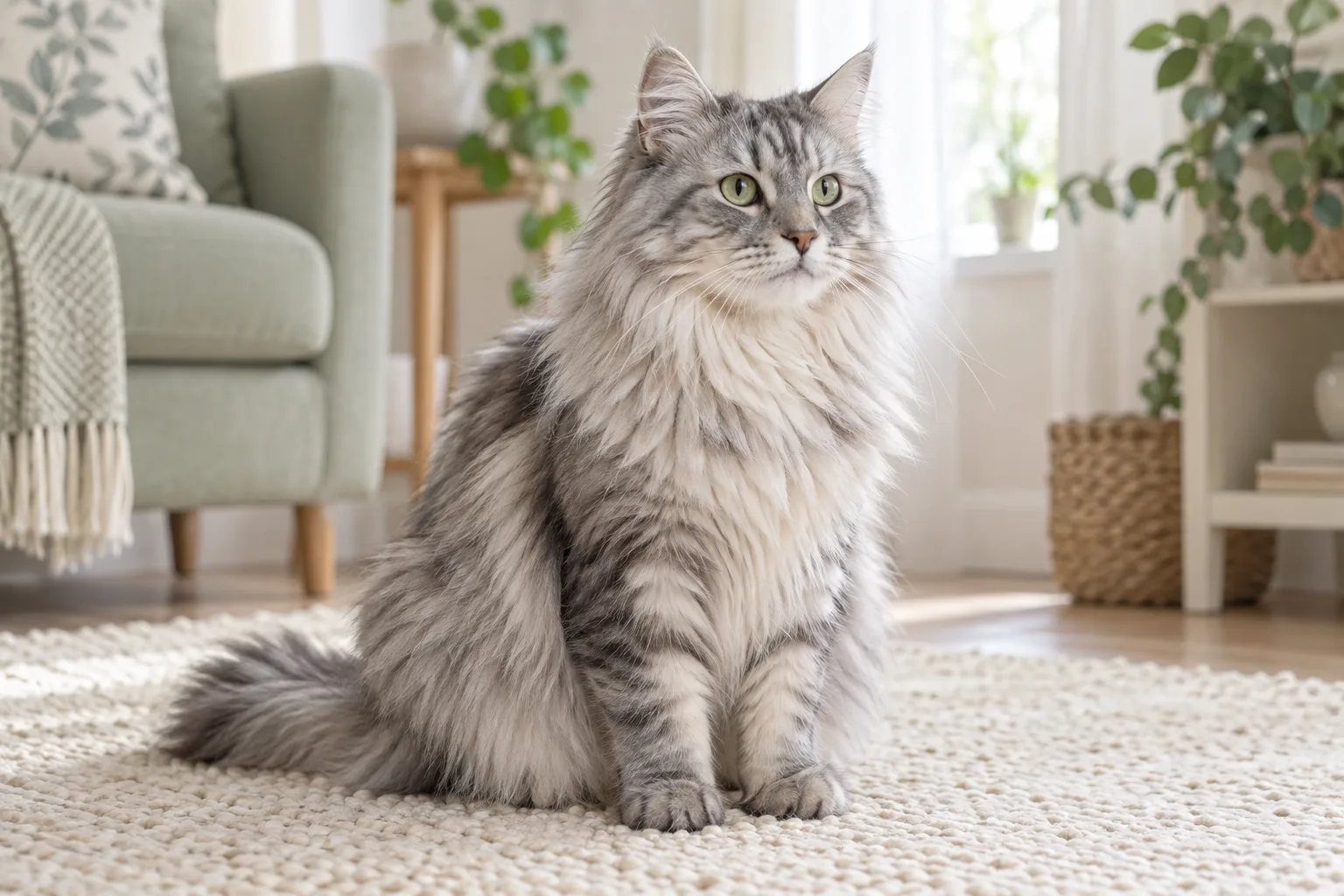
A mat is loose, shed hair that never made it out of the coat. It stays caught among the living hairs, gets moved around by friction, and slowly winds into a knot that pulls a little tighter every day.
Once you know that, matting stops being mysterious. It happens where shed hair collects, where the coat rubs, and where nobody is looking.
How a mat actually forms
Cats living indoors tend to shed at a low level all year round. PDSA explains why: how often a cat moults "can depend on how much exposure they have to daylight," which "means indoor cats often shed all year round." Most sources still describe heavier moults in spring and autumn — Merck notes cats "normally shed hair in the early spring and early fall" — so think of it as a steady baseline with seasonal peaks.
In a short single coat, loose hairs drop away or end up on your furniture. In a long or dense coat, many of them do not fall anywhere. They are held in place by the hairs around them.
Friction does the rest. Every time your cat walks, turns, lies down or is stroked, those trapped hairs shift and tangle with their neighbours. A loose tangle becomes a firm one. A firm one becomes a mat that sits against the skin and pulls whenever the cat moves.
That is why mats get worse rather than better on their own, and why a coat that seemed fine last month can knot surprisingly quickly.
Where it tends to start
Mats are not random. They appear where there is movement and friction, and in the places a cat cannot easily reach. Different welfare bodies name slightly different spots, and between them the picture is consistent:
- Behind and around the ears — named by the RSPCA.
- Under the front legs, in the armpits — named by the RSPCA, PDSA and International Cat Care, which notes the skin here "is very thin" and "extremely sensitive."
- The backs of the legs and the belly — RSPCA and PDSA.
- Between the hind legs — International Cat Care.
- The hindquarters, tail and lower spine — PDSA lists the tail; International Cat Care notes matting "over the lower spine and hindquarters" in older cats.
- Between the toes and pads — International Cat Care. Easy to forget entirely.
Worth knowing: PDSA points out that people tend to groom the easy parts and stop. "Remember not to only focus on the easy parts (the back and chest)," they write, "as the armpits, legs, tummy, and tail are danger zones for matting."
What speeds it up
Coat type. Long and dense coats trap far more shed hair than short single coats. Some cats knot despite regular grooming; others rarely mat at all.
Seasonal moults. More loose hair in the coat means more raw material.
Anything that stops a cat grooming itself. This is the one that gets missed. International Cat Care lists "less time spent grooming" and a "matted and scruffy coat" among the signs of arthritis in cats, and notes that "decreased grooming behaviours may indicate chronic (long-term) pain from arthritis or dental disease." The Feline Veterinary Medical Association adds that degenerative joint disease "affects over 90% of cats over 12 years of age," and that dental disease, hyperthyroidism and diabetes can all contribute.
Being overweight. The Feline Veterinary Medical Association observes that "overweight and obese cats often have soiling and dermatitis under their tails." We will not go further than that — no source we found actually says overweight cats cannot reach to groom, however reasonable that sounds.
Long gaps between grooming. Not because grooming is magic, but because it is the only thing removing the shed hair that mats are made from. For long coats, International Cat Care, PDSA and RSPCA Australia all recommend daily; the RSPCA's own adopter sheet and the ASPCA say every few days. Short coats are roughly weekly.
How to catch it early
You are feeling for texture rather than looking for lumps. Run your fingers against the lie of the coat in the spots listed above. Loose fur lifts. A forming tangle feels slightly denser and slightly springy. A real mat feels like a firm pad and does not move with the hair around it.
A wide-tooth comb tells you more than your hand does. If the comb stops, something is there.
Early tangles are easy. Set mats are not — which is the whole argument for looking regularly rather than grooming heroically.
Why mats matter more than they look
This is not only cosmetic. A 2022 paper in Frontiers in Veterinary Science describes knots that "can cause pain and discomfort such as skin tightness and pruritus," and reports that chronically matted hair "can contribute to and cause medical conditions such as skin irritation and infection, recurrent or chronic ear and ocular infections and disease, anal soiling and obstruction, fecal constipation and impaction, urine scalding, and parasitic infestations."
In severe cases, matted hair can encircle a limb and cut off circulation. That paper's severe cases were overwhelmingly long-haired dogs rather than cats, so we mention it as the far end of the scale, not as something to expect.
When to stop and get help
Mats close to the skin are not a home job. Do not cut a mat out with scissors — every welfare body is unusually blunt about this. International Cat Care: "it's extremely difficult to see where your cat's skin ends and the hair starts when it gets really matted, and you could cut your cat." The ASPCA: "NEVER cut mats out with scissors."
Ask a groomer or your vet when the mat is "very tight, close to the skin, very large, or you are worried about or unable to remove it yourself" — that is RSPCA Australia's threshold, and it is a good one. Severe matting may need clipping under sedation or anaesthetic, which sounds alarming and is simply the safe way to do it.
Speak to your vet, rather than reaching for a tool, if:
- a cat that used to groom itself has visibly stopped — the Feline Veterinary Medical Association asks owners to "report any change in grooming behavior to your veterinarian as soon as you notice it";
- matting appears suddenly and widely rather than in the usual friction spots;
- the skin under a mat looks red, broken or sore;
- your cat reacts with pain when a particular area is touched;
- the coat texture itself changes without a change in routine.
A coat is a decent early-warning system. A cat that stops looking after its fur is often saying something before anything else does.
The short version
Mats are made of hair your cat has already shed but not lost. They start where the coat rubs and where nobody checks — behind the ears and under the front legs are the spots most often named. They tighten rather than loosen. The cheapest fix by far is looking regularly, and the right move for a tight mat is a groomer or a vet, not scissors.
Source notes
Not veterinary advice. General information only; for any health concern about your cat, speak to your vet. No veterinary professional has reviewed this article.
- International Cat Care — Grooming your cat: mat locations, thin skin in armpits and hind legs, scissors warning, sedation. https://icatcare.org/articles/grooming-your-cat
- International Cat Care — Special considerations for senior cats: matting over the lower spine and hindquarters; grooming decline and chronic pain. https://icatcare.org/articles/special-considerations-for-senior-cats
- International Cat Care — Arthritis in cats: reduced grooming and a matted coat as signs. https://icatcare.org/articles/arthritis-in-cats
- Feline Veterinary Medical Association — Abnormal grooming: grooming as a health signal; arthritis described as affecting "over 90% of cats over 12 years of age"; soiling and dermatitis under the tail in overweight cats. https://catfriendly.com/signs-symptoms/abnormal-grooming/
- RSPCA (UK) — Grooming your cat: mat locations; dematting combs rather than scissors. https://www.rspca.org.uk/adviceandwelfare/pets/cats/health/grooming
- RSPCA Australia — How often do I need to groom my cat?: the threshold for professional help. https://kb.rspca.org.au/knowledge-base/how-often-do-i-need-to-groom-my-cat/
- PDSA — Grooming pets: the "danger zones" for matting. https://www.pdsa.org.uk/pet-help-and-advice/looking-after-your-pet/all-pets/grooming-pets
- PDSA — Why and when pets moult: daylight exposure and year-round shedding in indoor cats. https://www.pdsa.org.uk/what-we-do/blog/why-and-when-pets-moult
- Merck Veterinary Manual — Structure of the Skin in Cats: seasonal shedding. https://www.merckvetmanual.com/cat-owners/skin-disorders-of-cats/structure-of-the-skin-in-cats
- ASPCA — A haircut could save a life: irritation and infected lesions; scissors. https://www.aspca.org/news/haircut-could-save-life-preventing-your-pets-coat-matting
- McDonald et al. (2022), Frontiers in Veterinary Science, doi:10.3389/fvets.2022.827348: knots causing pain; downstream medical conditions. https://www.frontiersin.org/journals/veterinary-science/articles/10.3389/fvets.2022.827348/full
Corrections made in this revision: the previous version said "the five places above" while listing six spots, and repeated "five places" in the meta description. It also named trapped moisture as a mechanism (no source supports this) and implied overweight cats cannot reach to groom (not stated by any source we found). All three have been fixed.