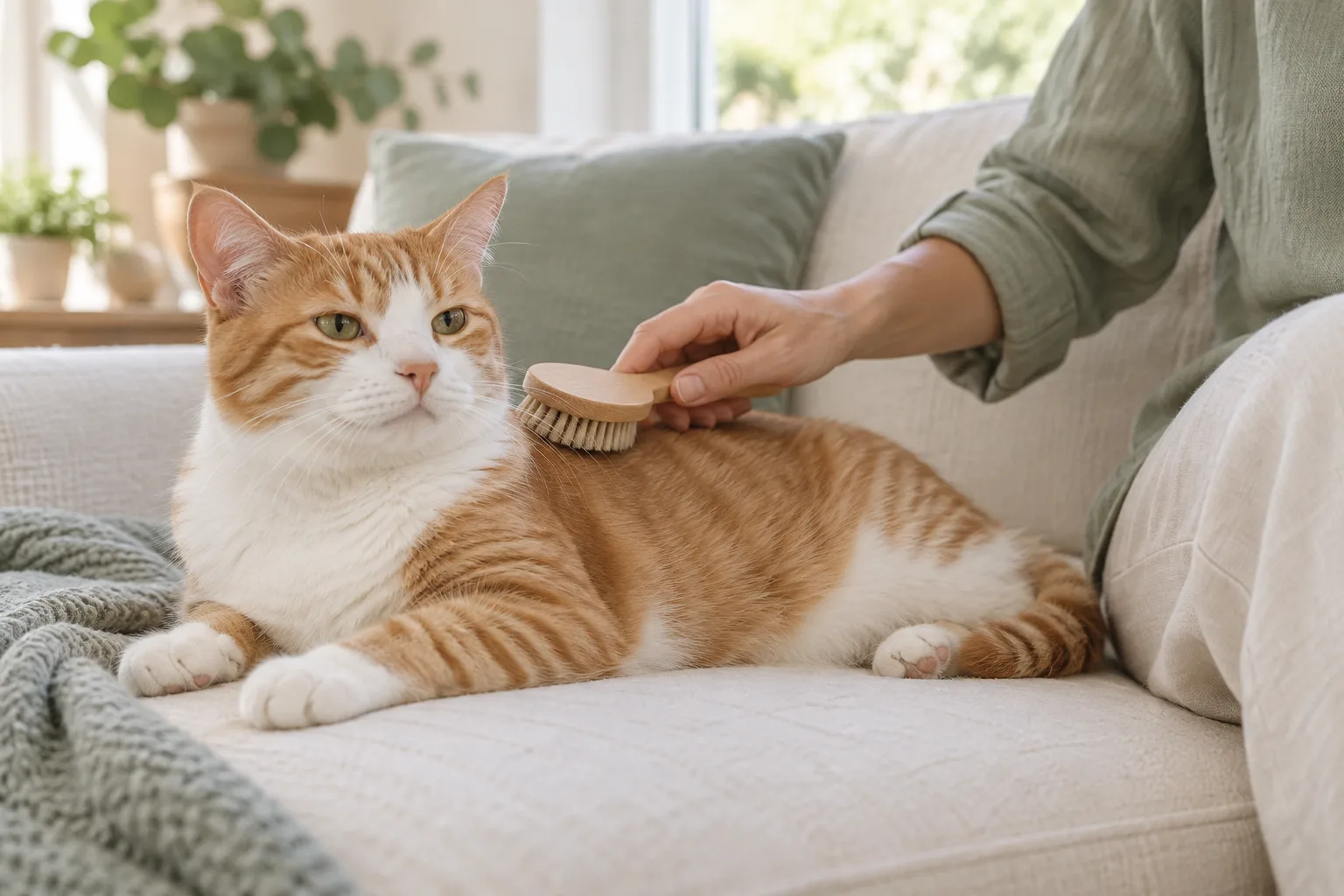
Most grooming routines fall apart for the same reason: they were built for an imaginary cat who sits still.
A routine that survives contact with a real one usually looks unimpressive on paper. It is short, it is unremarkable, and it happens often enough to stay ahead of the shed hair that mats are made from.
How often your cat actually needs it
This is the part most people guess at, and the honest answer is that it depends on the coat — and that sources do not entirely agree.
Long or dense coats. International Cat Care, PDSA and RSPCA Australia all recommend daily. International Cat Care puts it as "longhaired cats need to be groomed at least daily but only do this for as long as your cat is comfortable." The RSPCA's own adopter sheet is gentler — "at least every few days" — and the ASPCA also says every few days.
Short coats. Roughly once a week, consistently, across sources. International Cat Care: "aim to groom your cat at least once weekly."
Older cats, and cats with mobility problems, often need more. RSPCA Australia notes that some cats need grooming more often, "for example, older cats, or cats who might have trouble grooming because they have mobility or flexibility problems such as arthritis."
The distinction matters more than the exact number. A long-coated cat groomed once a week is not on a light schedule — shed hair is accumulating between sessions.
How long a session should be
Not a fixed number of minutes. We looked for one, and no veterinary or welfare body sets a session length. Every source defines it the same way: by the cat.
International Cat Care is the clearest — sessions "should be as short or long as your cat is comfortable with and should end before your cat shows any signs of discomfort." The RSPCA says to keep sessions short while a cat gets used to them, and "always finish while your kitten is still enjoying the experience."
So the target is not two minutes or ten. It is stop before your cat wants you to. That is the rule that makes tomorrow's session possible.
A routine that survives
- Same moment each day. Attach it to something that already happens — after feeding, before bed, while the kettle boils. "Daily" is not a plan; "after the evening feed" is.
- Use a comb if the coat has any length. Welfare bodies list combs for tangles and dead undercoat, and bristle brushes and mitts for distributing oils and finishing short coats. A brush over the top of a long coat can leave it looking fine while a tangle sets underneath — though we should say plainly that this is the logic of what each tool is designed for rather than a tested claim.
- Cover the friction spots on purpose. Behind and around the ears, under the front legs, the backs of the legs, the belly, between the hind legs, the hindquarters and tail, and between the toes. These knot first and a casual brushing misses them.
- Stop while it is still going well.
Everything else is an upgrade, not a requirement.
If your cat is not keen
Cats who dislike grooming usually dislike a specific part of it: being held, being handled somewhere sensitive, or the tool itself.
Start with what your cat already accepts. If they tolerate being stroked but not combed, stroke first and finish with a single stroke of the comb somewhere comfortable. Add one small step at a time. The Feline Veterinary Medical Association suggests much the same: "if your cat isn't a huge fan of being groomed, start with small sessions and give lots of breaks in between."
Two things help more than technique:
Something good happening during the session, not only at the end.
As little restraint as you can manage. A cat who gets held down learns that grooming is something that happens to them.
And when your cat says no, take the break. Stopping at the first objection costs you one unfinished session. Pushing through can cost you the routine.
The spots cats object to most are often the genuinely sensitive ones — International Cat Care notes the skin under the front legs and between the hind legs "is very thin" and "extremely sensitive." Worth knowing before deciding a cat is being difficult.
What else you are doing
A grooming routine is the most regular hands-on contact most cats get, which quietly makes it a health check. While your hands are in the coat you are noticing changes in texture, lumps, sore patches, weight, and whether your cat still enjoys being touched where they used to.
Two things are worth a conversation with your vet rather than an adjustment to the routine:
- A cat who used to groom themselves and has stopped. The Feline Veterinary Medical Association is direct: "a lack of normal grooming behavior can be an early sign that your cat does not feel well," and they ask owners to report any change as soon as they notice it.
- Matting that appears suddenly and widely, rather than in the usual friction spots.
And if you find a mat that is tight, close to the skin, or large, that is a groomer or a vet — not a pair of scissors, and not a tool you push harder with. RSPCA Australia's wording is the one to remember: seek professional help if the mat is "very tight, close to the skin, very large, or you are worried about or unable to remove it yourself."
Why routines fail in week two
Too long. Cut the session, don't skip the day.
No anchor. A time of day beats an intention.
The wrong tool for the coat. If the comb constantly snags, or slides over the top without reaching anything, the session becomes a fight — and the fight is what both of you remember.
None of this is about discipline. It is about making the correct version of the task small enough that it is easier to do than to skip.
The short version
Long coats daily to every few days; short coats weekly. A fixed moment, a comb rather than a brush if the coat has length, and deliberate attention to the spots that knot first. End the session before your cat wants you to — and hand a tight mat to someone with the right training.
Source notes
Not veterinary advice. General information only; for any health concern about your cat, speak to your vet. No veterinary professional has reviewed this article.
- International Cat Care — Grooming your cat: frequency for long and short coats; sessions ending before discomfort; thin, sensitive skin under the front legs and between the hind legs. https://icatcare.org/articles/grooming-your-cat
- RSPCA (UK) — Grooming cats adopter sheet: keeping sessions short; finishing while the cat is still enjoying it. https://www.rspca.org.uk/documents/1494939/7712578/GroomingCats.pdf
- RSPCA Australia — How often do I need to groom my cat?: frequency; older and arthritic cats; the professional-help threshold. https://kb.rspca.org.au/knowledge-base/how-often-do-i-need-to-groom-my-cat/
- PDSA — Grooming pets: frequency by coat length; matting "danger zones." https://www.pdsa.org.uk/pet-help-and-advice/looking-after-your-pet/all-pets/grooming-pets
- ASPCA — Cat grooming tips: long-haired indoor cats and grooming every few days. https://www.aspca.org/pet-care/cat-care/cat-grooming-tips
- Feline Veterinary Medical Association (Cat Friendly Homes) — Grooming essentials: small sessions and breaks. https://catfriendly.com/routine-care-grooming/grooming-essentials/
- Feline Veterinary Medical Association — Abnormal grooming: grooming change as an early illness sign. https://catfriendly.com/signs-symptoms/abnormal-grooming/
Corrections made in this revision: the previous version specified a two-minute session (no authority sets any session length), claimed that frequent grooming means "nothing has time to go wrong," and stated "comb, do not brush" as a rule. All three have been replaced with what sources actually support.