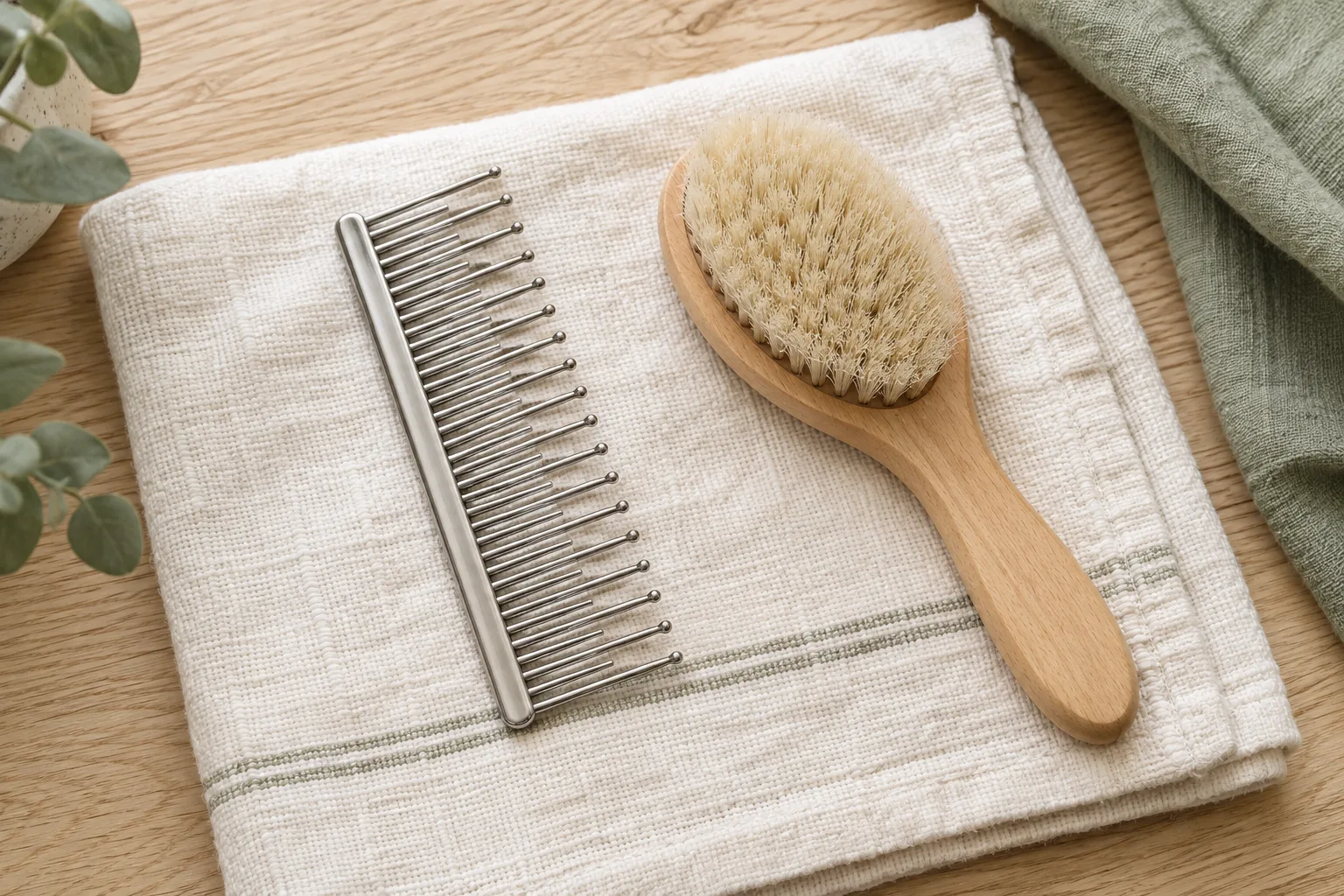
The grooming aisle offers a dozen tools that look broadly similar and cost anywhere from four dollars to forty. Most of them work. The catch is that they do different work, and the one that transforms a short-haired cat's shedding will barely touch a Persian's undercoat.
Here is what each tool is for, in plain terms. No single tool is best. What matters is your cat's coat and what you are actually trying to fix.
First, what are you trying to solve?
Three different jobs get lumped together as "grooming":
- Loose hair everywhere. Your cat is shedding and you would like to catch the hair before it reaches the sofa.
- Tangles and mats. The coat is knotting, usually in the same few spots, and it is getting worse rather than better.
- Routine upkeep. Nothing is wrong, and you would like to keep it that way.
Most long-haired cats need something for the second job and something for the third. Many short-haired cats are well served by the first alone.
Wide-tooth comb
A metal comb with widely spaced teeth.
What it is for: finding and working through tangles. Welfare bodies list combs as the tool for tangles and dead undercoat — the RSPCA's grooming sheet describes a moulting comb as "for the removal of tangles and dead undercoat," and a rake comb as one that "pulls out matted and dead undercoat."
What it will not do: clear large volumes of undercoat quickly, or fix a mat that has already set.
One honest caveat: you will read that combs reach deeper than brushes while brushes skate over the surface. That is a tidy story, and I could not find a veterinary source that supports it. The same RSPCA list assigns mat-breaking to a slicker brush. Treat comb-versus-brush as a difference in what each is designed for, not a proven difference in how deep they reach.
Fine-tooth comb
The same idea, teeth much closer together. Useful on the face, around the ears, and for going carefully through a small area. It is also what most people mean by a flea comb.
What it is for: detail work and close inspection.
What it will not do: get through a dense or knotted coat. It will snag, and your cat will remember.
Slicker brush
A flat or slightly curved head covered in fine, angled wire pins. The RSPCA lists it for "pulling out dead hair and breaking down matts," suitable for long-haired cats.
What it is for: lifting out loose hair and smoothing the coat.
What to watch: light pressure. Veterinary literature recognises brushing hard enough to irritate the skin as a trigger for a painful skin infection called post-grooming furunculosis — the clinical description names "traumatic brushing" alongside bathing and hand-stripping. That work describes dogs rather than cats, and it does not single out slicker brushes, so take it as a reason to be gentle rather than a reason to avoid the tool.
Pin brush
Widely spaced pins with rounded tips, set in a cushioned pad — much like a human hairbrush.
What it is for: gentle finishing and everyday use, especially with cats who dislike being handled.
What it will not do: much about a mat.
Undercoat rake
One or two rows of longer, widely spaced teeth designed to pass through the topcoat and pull loose hair from underneath. The RSPCA describes a rake comb as pulling "out matted and dead undercoat," suited to thick coats.
What it is for: long and dense coats during a heavy shed.
What to watch: rakes vary. Some have plain rounded teeth; others have edges that cut. Those are two different tools sold under one name, and it is worth knowing which one is in your hand.
Deshedding tool with a fine metal edge
The category with the close-set metal edge that pulls loose undercoat out quickly.
What it is for: removing a lot of loose hair in a short time.
What we can and cannot tell you: you will find confident claims online that these tools cut the coat and thin it over time. We looked for veterinary or peer-reviewed support and did not find any — in either direction. The one authoritative description we did find, from the Feline Veterinary Medical Association's owner site, treats a shedding tool as "like a heavy-duty grooming comb." So: use light pressure, stop when the tool stops filling, and watch the skin underneath. But we are not going to tell you a schedule that no authority has set.
Grooming glove
A mitt with soft rubber nubs. The RSPCA lists a grooming mitt for "removal of dead hair and polishing the outer coat," suited to short coats.
What it is for: cats who tolerate nothing else, and for getting a nervous cat used to being handled.
What it will not do: reach below the surface. Treat it as a first step.
Mat splitter or dematting tool
A hooked blade designed to cut a mat into smaller pieces.
Be careful with this one, and consider skipping it. Every welfare body we checked warns against cutting mats. International Cat Care puts the reason plainly: "it's extremely difficult to see where your cat's skin ends and the hair starts when it gets really matted, and you could cut your cat." The ASPCA adds the other half of the risk — "your pet can unexpectedly move or jerk resulting in a severe laceration or puncture."
What a cat actually needs
For most long-haired cats: a metal comb for finding and working through tangles, plus one shedding tool matched to how much the cat drops.
For most short-haired cats: a rubber mitt or a soft brush.
How often is a genuine question, and sources differ. International Cat Care, PDSA and RSPCA Australia all say daily for long coats. The RSPCA's own adopter sheet and the ASPCA say every few days. Everyone agrees short coats are roughly weekly. Somewhere in that range is your cat.
Add other tools only if you have a reason. A drawer of grooming tools is not a grooming routine.
When a tool is the wrong answer
Stop and get help rather than reaching for another tool if:
- a mat is tight against the skin, large, or you cannot slide a comb underneath it. RSPCA Australia's threshold is worth memorising: "If the matt is very tight, close to the skin, very large, or you are worried about or unable to remove it yourself, then professional help may be needed."
- the skin under a mat looks red, broken or sore. The ASPCA notes that "even very mild hair mats can cause skin irritation and progress to infected lesions."
- your cat reacts with pain, or a spot that was fine last week is suddenly sore.
- your cat has stopped grooming themselves. The Feline Veterinary Medical Association is direct about this: "a lack of normal grooming behavior can be an early sign that your cat does not feel well," and they ask owners to report any change in grooming to a vet as soon as they notice it.
Severe matting is a veterinary job, not a home one. International Cat Care notes that badly matted coats often need to be shaved by a veterinary team, and that this "often requires sedation or a general anaesthetic." That is not a failure on your part. It is the safe version.
The short version
Combs find problems. Brushes, rakes and mitts remove loose hair. Nothing in the aisle safely fixes a mat that has already set against the skin — that is a groomer or a vet.
Start with a comb. You cannot choose the rest sensibly until you know what your cat's coat is actually doing.
Source notes
Not veterinary advice. General information only; for any health concern about your cat, speak to your vet. No veterinary professional has reviewed this article.
- International Cat Care — Grooming your cat: scissors warning, mat teasing, shaving under sedation, frequency. https://icatcare.org/articles/grooming-your-cat
- RSPCA (UK) — Grooming cats adopter sheet: tool-by-tool descriptions, frequency. https://www.rspca.org.uk/documents/1494939/7712578/GroomingCats.pdf
- RSPCA Australia — How often do I need to groom my cat?: the professional-help threshold. https://kb.rspca.org.au/knowledge-base/how-often-do-i-need-to-groom-my-cat/
- ASPCA — A haircut could save a life: mats and skin lesions, scissors, sedation and clipping. https://www.aspca.org/news/haircut-could-save-life-preventing-your-pets-coat-matting
- Feline Veterinary Medical Association (Cat Friendly Homes) — Grooming essentials: shedding tool described as a heavy-duty comb; short sessions. https://catfriendly.com/routine-care-grooming/grooming-essentials/
- Feline Veterinary Medical Association — Abnormal grooming: grooming change as an illness sign. https://catfriendly.com/signs-symptoms/abnormal-grooming/
- PDSA — Grooming pets: frequency by coat length. https://www.pdsa.org.uk/pet-help-and-advice/looking-after-your-pet/all-pets/grooming-pets
- Today's Veterinary Practice — Post-Grooming Furunculosis: "traumatic brushing" as a trigger. Described in dogs. https://todaysveterinarypractice.com/toxicology/post-grooming-furunculosis/
Claims deliberately removed in this revision, because no authoritative source supports them: that deshedding tools cut the coat or thin the topcoat; that such tools should be used "periodically, not weekly"; that combs physically reach deeper than brushes; and the term "brush burn."